Most people who’ve been in crypto for more than a few weeks have bought the same coin more than once. Maybe you bought Bitcoin at $100000, then again at $85000 when it dipped, and again at $63000 when it dropped further. At that point you’re no longer asking “is Bitcoin up or down” — you’re asking something more specific: what’s my actual average entry price, and am I in profit right now?
That number matters more than most people realise. It’s the difference between knowing your position and guessing at it.
What Is Average Buy Price in Crypto?
Your average buy price — sometimes called your average cost basis — is the mean price you’ve paid for a coin across all your purchases, weighted by how much you bought each time.
It’s not a simple average of the prices. It accounts for the quantity bought at each price point, which is what makes it a weighted average. If you bought 0.1 BTC at $60,000 and then 0.5 BTC at $30,000, your average isn’t $45,000. The second purchase was five times larger, so it pulls the average down much closer to $30,000.
Getting this number right matters for three reasons. First, it tells you whether you’re actually in profit before you sell. Second, it gives you a clearer picture of how much the price needs to move in your favour before you break even. Third, your cost basis is what the tax calculation is based on in most jurisdictions — getting it wrong means calculating your gains or losses incorrectly.
The Formula — How It Works
The weighted average formula is straightforward:
Average Buy Price = Total Amount Spent ÷ Total Quantity Purchased
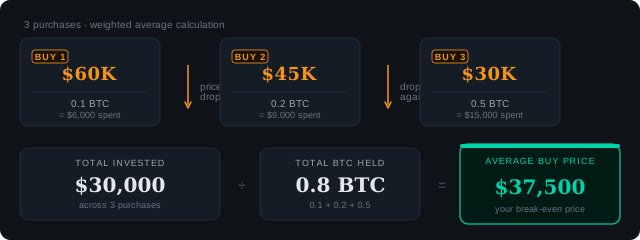
Lets assume you bought Bitcoin across three purchases:
- 0.1 BTC at $60,000 = $6,000 spent
- 0.2 BTC at $45,000 = $9,000 spent
- 0.5 BTC at $30,000 = $15,000 spent
Total spent: $30,000
Total BTC: 0.8 BTC
Average buy price: $30,000 ÷ 0.8 = $37,500
At $37,500 per BTC you break even. Below that you’re at a loss. Above it you’re in profit.
Simple enough with three entries. But what if you’ve been dollar-cost averaging weekly for six months? Or you’ve bought across multiple exchanges and wallets at different times? Doing this manually for 20 or 30 purchases becomes tedious and error-prone.
That’s where a dedicated calculator saves time.
Calculate Your Average Buy Price Instantly
Our Average Cost Calculator handles hundereds of entries and works for Bitcoin, altcoins, stocks, and forex. Enter each purchase quantity and price, select your currency, and it gives you the weighted average cost, total invested, and a full breakdown by entry — instantly.
What Is Averaging Down — and Does It Actually Help?
Averaging down is when you buy more of a coin after the price has dropped from your initial entry. Because you’re adding to your position at a lower price, your average cost per coin falls.
Using the Bitcoin example above — if you bought at $60,000 and the price dropped to $30,000, buying more at $30,000 brings your average down. You now need a smaller price recovery to break even than if you’d held only your original position.
There’s a genuine benefit to this when you have conviction in an asset. It’s one of the reasons dollar-cost averaging — buying fixed amounts at regular intervals regardless of price — became popular during the 2022 bear market. Investors who DCA’d through the downturn found their average Bitcoin buy price landed somewhere in the $20000–$35000 range, well below the previous cycle’s peak.
The risk is that averaging down assumes the price eventually recovers. If it doesn’t — or if it takes years — you’ve increased your exposure without the payoff. Averaging down into a failing project is a different calculation entirely from averaging down into Bitcoin.
Averaging Up — When You Add at Higher Prices
The same logic works in reverse. If you bought Bitcoin at $30,000 and then bought more at $60,000 because you believed in the trend, your average cost rises. You now need the price to stay above your new average to remain in profit.
This is less emotionally uncomfortable than averaging down but it’s still worth tracking carefully. Many traders who averaged up aggressively near Bitcoin’s all-time highs in 2021 found themselves sitting on significant unrealised losses when the market corrected.
Knowing your exact average at any point is what keeps you grounded in the actual numbers rather than how you feel about the trade.
Cost Basis and Crypto Taxes
Your average buy price forms the foundation of your cost basis — the figure used to calculate capital gains or losses when you sell.
In most countries, if you sell crypto for more than your cost basis, the difference is a taxable gain. If you sell for less, it’s a loss that may be deductible against other gains.
For example, if your average Bitcoin buy price was $37,500 and you sell 0.5 BTC at $70,000:
Sale proceeds: $35,000
Cost basis (0.5 BTC × $37,500): $18,750
Taxable gain: $16,250
Different countries apply different rules — some use FIFO (first in, first out), others allow average cost method. The specific method your jurisdiction requires affects how the calculation works. Worth checking with a local tax advisor if your position is significant.
For a rough estimate of your profit or loss at current prices, our Crypto Profit Calculator takes your buy price, quantity, and current price to show your unrealised gains instantly.
Frequently Asked Questions
What is the average buy price of Bitcoin right now?
The average buy price is personal to each investor — it depends on when and how much you bought. What people often mean by this question is the average cost basis across all Bitcoin holders, which on-chain analytics firms like Glassnode track. For your own position, the calculator above gives you the exact figure based on your purchase history.
Does averaging down always reduce my break-even price?
Yes, mathematically it always lowers your average cost. Whether that’s a good strategy depends on your conviction in the asset, your risk tolerance, and how much capital you’re committing.
Can I use this calculator for altcoins and stocks?
Yes. The formula is identical regardless of the asset. The calculator works for any cryptocurrency, stock, ETF, or forex position. Just enter the quantity and price for each purchase and it calculates your weighted average across all entries.
How many purchases can I track at once?
The calculator supports unlimited entries and you can add as many rows as needed. If you have more purchases, for example more than 20 then you can group those by calculating a running average and entering that as a single row.
What’s the difference between average buy price and cost basis?
They’re closely related but not identical. Average buy price is the weighted mean price you paid per unit. Cost basis includes any additional costs — exchange fees, gas fees, conversion costs — added to the purchase price. For a precise tax calculation, include fees in your cost basis. For a quick profit/loss check, average buy price alone is usually sufficient.
Hope it helps.