Crypto Market Cap Potential — What These 5 Coins Could Be Worth at a Higher Cap

Comparing market cap is one of the most grounded ways to think about crypto price potential. The logic isn’t complicated — if a coin’s circulating supply stays roughly the same but demand pushes its market cap to where a bigger coin sits today, what does that mean for the price?
It doesn’t require any technical analysis or chart reading. Just two numbers: market cap and supply. We ran these numbers on five coins currently sitting below coins they’re often compared to. The figures below are based on market caps as of early 2026, so treat them as a rough framework rather than a precise forecast — markets move, supplies change, and nothing in crypto is guaranteed.
1. Solana (SOL) — What If It Reached Ethereum’s Market Cap
Solana has been one of the more interesting stories in crypto over the past few years. It’s carved out a real user base, hosts a significant chunk of DeFi activity, and has recovered from some ugly moments including the FTX fallout in 2022.
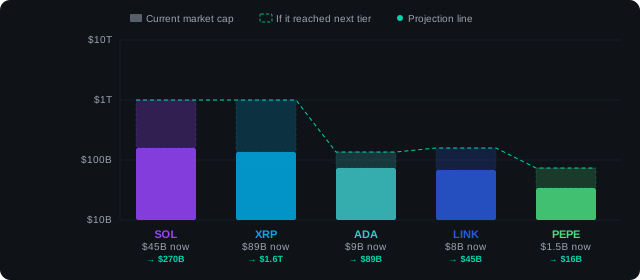
Right now SOL sits at roughly a $40–50 billion market cap depending on the day. Ethereum is somewhere around $270 billion. That’s about a 5–6x gap.
If Solana’s market cap grew to match Ethereum’s current valuation — at its circulating supply of around 450 million coins — the price would land somewhere around $600. That’s versus roughly $90–95 today.
Is that realistic? Maybe not soon. But Solana has already had a run from single digits to $260 during the last bull cycle. The infrastructure is there. The comparison isn’t crazy.
You can run this yourself using our Crypto Market Cap Comparison Tool — just plug in SOL and ETH and it calculates the price scenario instantly.
2. XRP — What If It Reached Bitcoin’s Market Cap
XRP is a strange one to analyse because so much of its price history has been tied to the SEC lawsuit rather than fundamentals. Now that the case is effectively behind it, the coin is trading more freely.
XRP’s circulating supply is around 61 billion tokens. Bitcoin’s market cap sits near $1.6 trillion. If XRP somehow reached that level — and that’s a massive if — the price would be around $26. From roughly $1.45 today, that’s close to an 18x.
More conservatively, matching Ethereum’s current market cap of $270 billion would put XRP at about $4.35. That’s a 3x from current levels and a scenario that at least feels within the realm of possibility given the coin’s momentum since Ripple’s legal win.
3. Cardano (ADA) — If It Reached XRP’s Market Cap
People have been writing off Cardano for years. The “always building, never shipping” criticism stuck around for a while, and to be fair, it wasn’t entirely unfair. But the network is further along than it gets credit for, with smart contracts live and DeFi activity growing — slowly, but growing.
ADA’s market cap is sitting around $9–10 billion. XRP is at roughly $89 billion. That’s a 9x gap in market cap terms.
At XRP’s current market cap, with ADA’s circulating supply of about 35 billion tokens, ADA would be priced at roughly $2.55. That’s a meaningful jump from $0.27.
The caveat here is supply. ADA has a lot of tokens in circulation and the total is still growing — that dilutes price appreciation compared to coins with fixed or tighter supply.
4. Chainlink (LINK) — The Infrastructure Play
Chainlink doesn’t get as much retail attention as the above coins but it occupies a genuinely important role — it’s the infrastructure that lets smart contracts interact with real-world data. Every DeFi protocol that needs a price feed, most of them use Chainlink.
LINK’s market cap is around $8–9 billion. For context, that puts it below Cardano and well below coins like BNB at $95 billion.
If LINK reached Solana’s current market cap (roughly $45 billion), the price would land around $80. That’s from about $14 today — roughly a 5–6x.
The argument for LINK is that its value is tied to how much the broader DeFi ecosystem grows, not just speculation. More protocols, more chains, more oracle usage. The market hasn’t fully priced in that growth story yet.
5. PEPE — The High-Risk Meme Coin Case
Including PEPE here feels a bit different from the others because there are no fundamentals to point to. It’s a memecoin. But the market cap comparison angle is actually where meme coins produce the most eye-catching numbers — because the supply is enormous, even small market cap moves translate to wild price swings.
PEPE’s supply is around 420 trillion tokens. Its market cap is currently about $1.5–2 billion.
If PEPE reached Dogecoin’s current market cap of around $16 billion, the price would go from roughly $0.000004 to about $0.000038. A 9–10x.
If it reached Shiba Inu’s market cap — a more direct peer — the math would put PEPE around $0.000010, still a significant jump from where it is now.
That said, meme coins are driven almost entirely by attention cycles. There’s no predicting when or whether those come. The numbers above are arithmetic, not forecasts.
How to Run Your Own Comparison
The scenarios above are snapshots — by the time you read this the prices will have shifted, and the scenarios will look different. That’s why it’s worth running these calculations yourself with current data.
Our Crypto Market Cap Comparison Tool pulls live prices and market caps for over 8,000 coins. You pick two coins, it shows you both market caps side by side and calculates exactly what price Coin A would be if it had Coin B’s market cap — and vice versa.
It’s a quick reality check before making any investment decision.
A Note on What This Analysis Doesn’t Tell You
Market cap comparison is a useful mental framework but it leaves out a lot. It doesn’t account for token unlocks that dilute supply, different use cases, liquidity differences, or whether a coin can sustain demand at a higher valuation. A coin reaching Bitcoin’s market cap requires Bitcoin-level adoption and conviction from the market — that’s not a given for most projects.
Use these comparisons as a starting point for research, not a conclusion. The math is simple; the reality is considerably more complicated.
This post is for informational purposes only and does not constitute financial advice. Crypto markets are volatile and past performance is not indicative of future results.